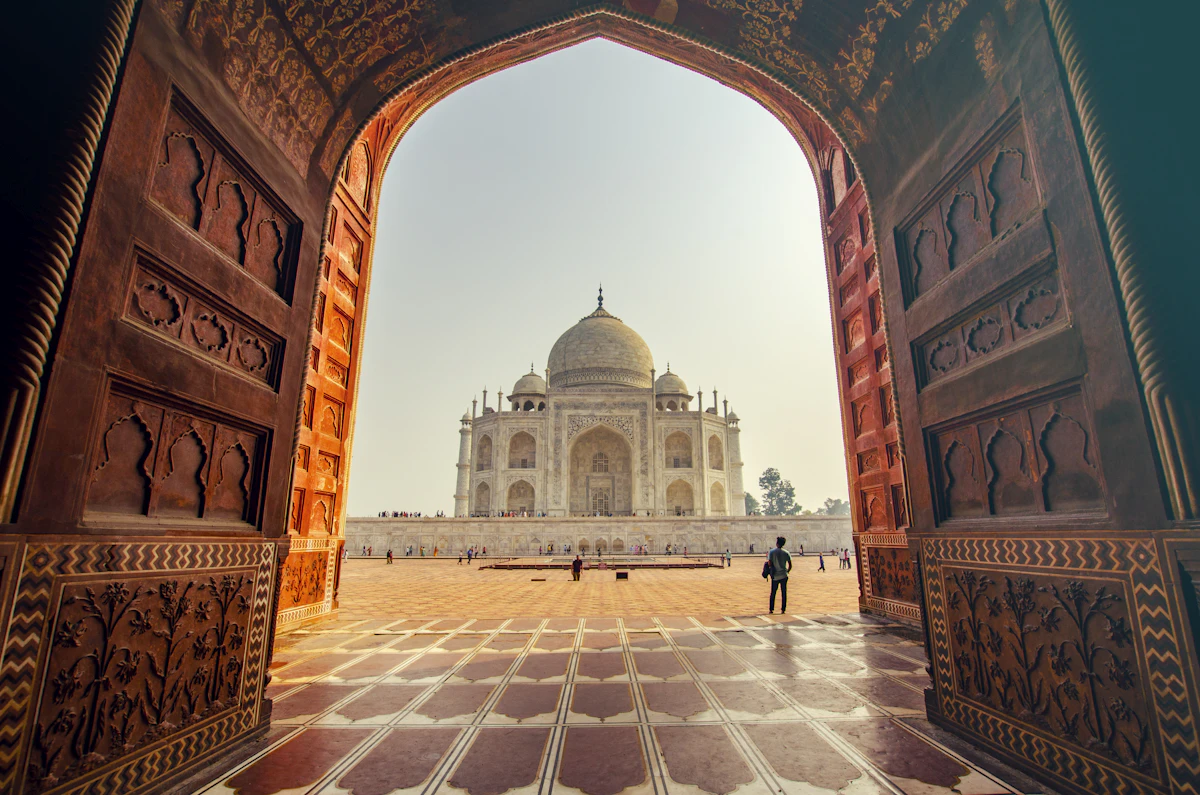
An In-Depth Journey into Shah Jahan's Love, Architecture, Museum Artifacts & Immersive 3D Street View
At Namaste Taj Mahal Tours, we take immense pride in hosting international tourists and heritage explorers from across continents who travel to Agra to witness India's greatest crown jewel. To give you the richest possible insight before your arrival, this comprehensive guide covers the detailed history of the Taj Mahal, the emotional catalysts behind its construction, the secrets of the Taj Museum, and an interactive 3D virtual tour experience.
The Taj Mahal is universally celebrated as one of the New Seven Wonders of the World. In July 2007, following a massive worldwide campaign with over 100 million votes, it secured its place among humanity's greatest achievements. But what makes it truly world-famous? Unlike grand political palaces, military forts, or religious cathedrals built to display power, the Taj Mahal was born entirely out of profound grief, personal devotion, and immortal romance[cite: 6].
Its global fame is cemented by its peerless Indo-Islamic architecture, flawless symmetry from every conceivable angle, delicate pietra dura marble inlay stonework, and its magical ability to change colors under changing daylight—glowing soft pink at dawn, milky white at noon, and shimmering silver under a full moon.
To truly understand the Taj Mahal, one must look deep into the 17th-century Mughal dynasty. In 1612, Prince Khurram—who later ascended the throne as Emperor Shah Jahan—married Arjumand Banu Begum, who was given the esteemed title Mumtaz Mahal (meaning "Chosen One of the Palace")[cite: 6].
While royal marriages of that era were predominantly strategic alliances, Shah Jahan and Mumtaz shared an intense, inseparable bond of companionship and mutual respect. She was his most trusted confidante, accompanying him across rugged terrains on military campaigns and advising him on crucial affairs of state[cite: 6].
The tragic turning point occurred in 1631 during a military expedition in Burhanpur. Mumtaz Mahal passed away due to post-partum complications while giving birth to their 14th child, a daughter named Gauhara Begum[cite: 6]. Emperor Shah Jahan was struck by an unbearable grief so profound that contemporary chroniclers note his hair turned gray almost overnight. Before her passing, Mumtaz extracted promises from the emperor, including the care of their children and the commission of a mausoleum unlike anything the world had ever seen[cite: 6]. This heartbreaking personal tragedy became the sole driving force behind the creation of the Taj Mahal.
Planning for the mausoleum began immediately in 1631, and actual construction commenced in 1632. The main tomb structure was completed around 1643, while the surrounding gardens, guest houses, and majestic entry gateways were finalized around 1653—bringing the total construction span to over 22 years.
An incredible workforce of over 20,000 artisans, master stonemasons, calligraphers, and architects was assembled from across India, Persia, Central Asia, and Europe. While Emperor Shah Jahan maintained strict personal oversight over the artistic vision and proportions, the primary architectural blueprint was conceived by the legendary master architect Ustad Ahmad Lahauri.
The material logistics were monumental: pure white Makrana marble was carted from Rajasthan, while rare precious and semi-precious inlay stones—such as lapis lazuli, turquoise, jade, crystal, and carnelian—were imported from Tibet, Sri Lanka, Persia, and parts of Europe. Over 1,000 trained elephants were deployed to transport heavy building blocks across rivers and roads to the southern bank of the Yamuna River in Agra.
Explore the majestic gardens, main mausoleum, and surrounding architecture of the Taj Mahal in clear 3D perspective right from your screen:
The Taj Mahal is filled with ingenious architectural and optical engineering feats that visitors discover during private tours:
Located inside the Taj Mahal complex within the western Jalali Room, the Taj Museum is a treasure trove for history lovers. Established during the British administration in the early 20th century, it houses authentic royal relics and historical documents that shed light on Mughal life.
Key Artifacts on Display:
Ironies of history dictated that shortly after completing his monumental creation, Shah Jahan was deposed in 1658 by his ambitious son, Aurangzeb. He spent his final years under house arrest in the nearby Agra Fort, spending hours gazing across the Yamuna River at the white marble shrine of his late wife. Upon his death in 1666, his remains were placed beside Mumtaz Mahal in the underground crypt—the only asymmetrical feature in an otherwise perfectly symmetrical complex[cite: 6]. Today, it remains an eternal beacon of human heritage and romantic devotion.
Experience luxury private car transfers, police-verified chauffeurs, and certified multilingual tour guides for international travelers.